
What McDonald’s Burger-Bite Tells Every Comms Leader About Narrative Control — and the Data Anomaly That Changes the Story
Most crises don’t fail at the moment of impact. They fail in the aftermath when a leader who survived the first wave walks back into the fire.
The McDonald’s “Burger-Bite” incident, involving CEO Chris Kempczinski, is a great case study in that dynamic. The media data tells a clean, readable story. But beneath the obvious crisis arc lies a counter-narrative that’s easy to miss — one that has real implications for how CCOs think about CEO visibility, brand risk, and what “winning” actually looks like in the middle of a media storm.
The shape of the crisis
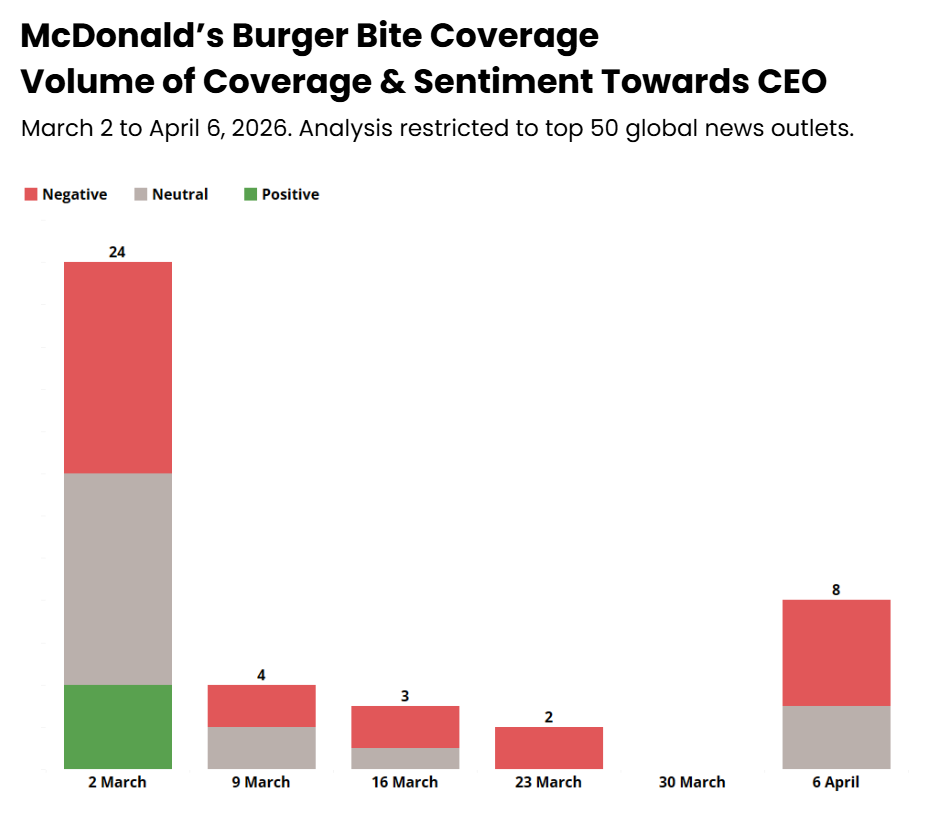
Look at the chart above before anything else. What you’re seeing is what one might call a “two-wave crisis”.
Wave one arrived the week of March 2, when Kempczinski’s Big Arch taste-test video really circulated. Coverage peaked at 24 articles across major media outlets*, with the majority carrying negative sentiment toward the CEO. The story was sharp, fast, and — critically — it didn’t stay contained to the CEO. The McDonald’s brand tag mirrored the CEO tag almost exactly across those peak days. That near-identical shape is a structural finding: when a CEO speaks directly to a consumer audience, the brand absorbs reactions in real time. The CEO’s personal channel is a brand channel, whether or not it’s been designated as one.
The decay phase, stretching from the week of March 9 through March 30, showed the story doing exactly what viral stories (often) do when left alone: collapsing. Volume dropped to single digits, then to near-zero. Tone became mixed but inconsequential. By the end of March, the cycle had effectively run its course.
Wave two — the week of April 6 — shouldn’t have happened.
When Kempczinski appeared on the WSJ podcast and, in a subsequent moment that quickly gained traction, attributed his eating habits to his mother, coverage jumped back to eight articles with a sentiment profile that was almost entirely negative. He didn’t introduce new news. He handed outlets a fresh hook to replay old news. Headlines like “blasted again” and “blames his mom” weren’t covering a new event — they were re-litigating March 2 through a newly established frame: the CEO who keeps stepping in it.
Once that frame is set, it becomes the default interpretive lens. Any follow-up comment, however lighthearted, gets read as confirmation of the narrative rather than a correction of it.
The three lessons the data makes undeniable
Silence beats re-engagement once a viral moment has peaked. PublicRelay’s data shows coverage was already dead by late March. The April media push revived the narrative instead of rehabilitating it. Unless a factual error is actively compounding or the situation demands accountability, the correct post-peak posture is disciplined quiet. For communications leaders, that means having the organizational standing to tell a CEO: not now, and here’s the data that proves it.
Humor-as-deflection must close a loop, not reopen one. Self-deprecating levity can work as a crisis communication tool. But it only works when it signals that a chapter has ended. “My mom taught me to eat that way” did the opposite, giving every outlet a reason to re-run the original clip. The test is whether a comment provides a new angle on an old story. If it does, it’s not deflection. It’s a second act.
CEO social presence requires brand co-ownership, not brand awareness. The near-identical coverage lines for the CEO and McDonald’s brand during peak days make the case plainly. For any direct-to-public CEO content — social posts, podcast appearances, short-form video — the brand communications team should hold co-authorship. The CEO’s audience is the brand’s audience. The risk is shared. The process should be too.
The counter-narrative — and why it matters more than the crisis
Here is where the data gets genuinely interesting.
At the same time that earned media coverage was running predominantly negative, Kempczinski’s CEO Index score moved in the opposite direction.
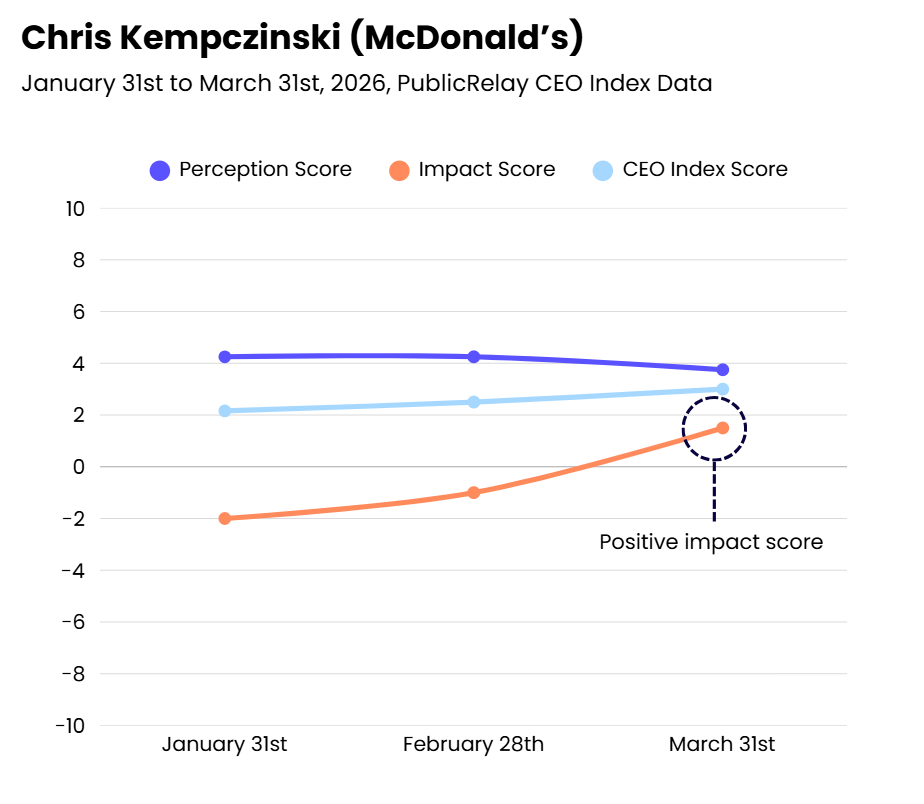
PublicRelay’s CEO Index rates CEO media performance from -10 to 10 on two factors:
Perception: We assess how each CEO is perceived in the media by measuring the sentiment, sharing and reach of their personal media mentions.
Impact: We assess how each CEO impacts their company’s media reputation by measuring the sentiment, sharing and reach of their company’s media mentions where the CEO is also mentioned.
In January, Kempczinski’s index score sat at 2.16, ranked 40th, with negative perception and negative impact. By February, it had risen to 2.50 and rank 34 — still modest, still negative on both sub-scores. Then in March — the month the video landed, the coverage spiked, and the negative headlines dominated — his score jumped to 3.00 and rank 25, recording his first positive impact score in the preceding 12-month tracking window.
To understand why, you have to look at what January and February actually contained.
That stretch was characterized by Kempczinski largely on the defensive in earned media. Coverage was dominated by lower-income consumer flight driven by pricing concerns, franchisee unrest and a public “Franchisee Bill of Rights” dispute, and commentary about declining foot traffic. It was the coverage of a CEO managing headwinds — competent, perhaps, but reactive and abstract. Nothing in it was humanizing. None of it made Kempczinski a person rather than a corporate spokesperson.
Then a short video of him eating a burger created more recognizable, human coverage in one week than two months of analyst-call quotes had produced. Whatever its reputational costs in earned media tone, the viral moment did something qualitatively different: it made him visible as an individual. And PublicRelay’s CEO Index data suggests that for the stakeholder audiences it tracks, humanization — even clumsy humanization — registered as positive impact where sustained managerial defensiveness had not.
This is not a license for unscripted CEO content. But it is a meaningful data point for CCOs constructing CEO communications strategy: invisible and cautious is not automatically safer than visible and imperfect. The index improvement in March happened because the CEO was seen. The narrative damage in April happened because he kept talking after the story had closed.
The lesson isn’t “go viral.” It’s “understand what your CEO’s silence is costing you before you assume it’s protecting you.”
What to bring into your next CEO comms review
The McDonald’s case is useful precisely because the data is unusually clean. Two waves. A clear decay window. A self-inflicted revival. And an index trend that runs counter to the sentiment headlines.
For CCOs and communications leaders, the practical outputs are specific:
Audit the approval chain for CEO direct channels. Who has genuine authority to delay or modify a CEO post, podcast appearance, or interview? If the answer is “we review after the fact,” the process is inadequate. The coverage data confirms these aren’t personal channels. They’re brand channels operated by the CEO.
Define what “the story is fading” looks like in your monitoring data. Build a threshold — volume, velocity, sentiment ratio — below which proactive CEO re-engagement is prohibited without explicit comms sign-off. Put it in writing before you need it.
Pressure-test every deflection comment against one question: does this give journalists a hook to replay the original incident? If yes, it doesn’t close the loop. It reopens it.
Track CEO Index alongside sentiment. Tone metrics tell you what journalists are writing. Index data tells you what it’s doing to perception among the stakeholders who matter. Those two signals don’t always move together — and the gap between them is often where the real story lives.
The McDonald’s case is a reminder that data is everywhere and meaning is rare. The sentiment chart tells one story. The CEO Index tells another. The comms team that sees both — and acts on the tension between them — is the team that protects the brand and the leader.